Slope easement
A graded hillside someone else may maintain.
What it is
A slope easement covers a cut or fill slope on graded land — the engineered hillside holding up a road or a building pad. An agency or developer keeps the right to access it and keep it stable.
This is the easement type where the general rules are weakest. Who maintains the slope, and who pays if it fails, varies more here than anywhere else — the recorded instrument is the only place that reliably answers it.
How to check for it
- Get a copy of the recorded instrument. For slopes this is not boilerplate advice: the document does nearly all the work, and failure is expensive.
- Look at the graded slopes on, above, or below your lot — whose land are they on, and who seems to be maintaining them?
- Ask the agency, developer, or HOA who holds the slope rights for your tract.
- Check your title report and any geotechnical reports from when the lot was graded.
How to request maintenance
- Read the instrument first, so you know who actually bears the duty — guessing wrong here is expensive.
- Report warning signs promptly and in writing to the holder: new cracks, leaning fences or walls, fresh seepage, soil piling at the toe.
- Photograph the slope with dates, seasonally — slow movement is visible across time in a way it never is in a single visit.
- Do not cut into, re-grade, or add load (walls, pools, heavy fill) at the top or toe of a slope without engineering advice.
One free thing you can do today: Get a copy of the recorded instrument. For slope easements specifically, the general rules are weak and the document does nearly all the work.
What you would do with this
This is an illustration of how the report is used, not an account of something that happened. Nobody here is a real homeowner, and what any particular situation is worth or costs depends on facts this tool cannot see.
- The situationPart of the lot is a graded bank you cannot build on, and you are not sure whether that is a rule, an easement, or just the shape of the ground.
- What the report showsThat slope easements are treated conservatively here, what is generally restricted on a graded bank, who carries responsibility for its stability, and what the recorded instrument should say about alteration.
- What you doGet the recorded document before you plan anything on the bank, and before you buy if you have not yet.
- What that gets youYou know which part of the lot is genuinely usable before you pay for it or plan around it — and a slope easement is one of the easements most likely to be mistaken for ordinary back garden.
How it affects home value
Slope easements usually take area that was unbuildable anyway, so the direct value effect is often small. Liability for a failure is the part that is not small.
When this goes wrong
The hillside that kept moving — Rancho Palos Verdes, 2023–2024
What happened
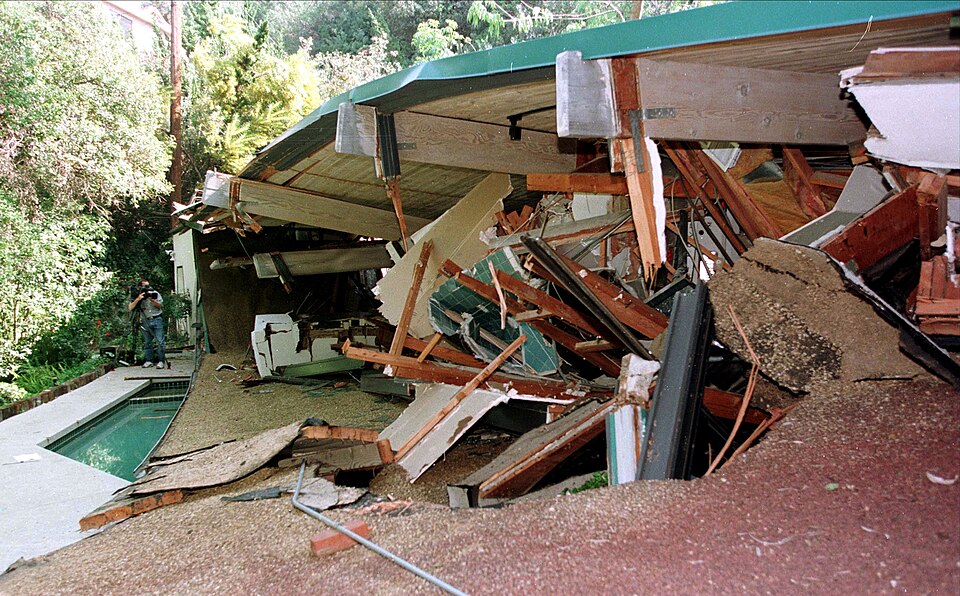
After the wet winters of 2023 and 2024, the ancient Portuguese Bend landslide complex in Rancho Palos Verdes accelerated from inches per year to as much as 9–12 inches per week. The ground movement broke water and gas distribution pipes, displaced sanitary sewer lines (including a roughly 10,000-gallon sewer spill in August 2024), and leaned utility poles. SoCalGas cut service to about 135 homes in July 2024; Southern California Edison cut power to about 140 homes and 53 businesses that September. Roughly 20 homes were red-tagged as uninhabitable; driveways dropped 6–10 feet below the houses they served. The governor declared a state of emergency. Residents paid for repairs out of pocket — including retirement savings — because standard homeowners policies exclude earth movement.
Why it happened
The slide plane is a bentonite clay layer hundreds of feet down — ancient volcanic ash that loses strength when wet. It cannot be excavated or reinforced from above; the city’s dewatering wells only slow it. Slope easements exist precisely because graded hillsides need permanent cut-and-fill support and drainage control — and once the ground starts moving, the structures on it go with it regardless of who maintained what.
Could this happen at your property?
If your lot was graded — cut into a hill, filled at the edge, terraced — the slope easement on your parcel marks where the hill is allowed to push. Look for the early signs: doors that stop closing, cracks stepping through stucco, driveways separating from garage floors, leaning retaining walls. And read your policy’s earth-movement exclusion now, not after the hill moves.
Sources
Keep in mind
These are the arrangements that are usual for this kind of easement. They are not a reading of your easement document and not legal advice — your document controls, and it can say the opposite of anything here. Use this to work out which questions are worth asking, then confirm the answers against the recorded instrument or with an attorney licensed in your state.